 Phuket Training
Strength training for menopause: a practical guide for women in Phuket
If you are in your forties or fifties and suddenly your body feels like it belongs to someone else, weight settling around the middle, strength slipping, energy and sleep all over the place, you are not imagining it, and you are not doing anything wrong. Menopause changes how your body holds muscle, bone and fat. The good news is that there is one thing shown, again and again, to push back against almost all of it: strength training.
This is not about becoming a bodybuilder or spending hours in a gym. It is about lifting some weights a couple of times a week to protect the muscle and bone you are otherwise losing, steady your metabolism, and feel strong and capable through a stage of life that too often gets framed as decline. Health bodies from UCLA Health to Stanford Lifestyle Medicine now put strength training at the centre of midlife women's health, and the research is clear that resistance training counteracts the muscle and strength loss of these years.
I am Jeejee, a NASM-certified personal trainer in south Phuket, and a lot of the women I coach are navigating exactly this. This guide explains what is actually happening to your body, why strength training helps so much, how often to train and what to do, how to handle menopause weight gain, and how to start safely, whether you are brand new to lifting or getting back into it. It pairs closely with my personal training over 40 guide, which covers the broader picture.
Why menopause changes your body
The driver behind most menopause body changes is falling oestrogen. Oestrogen does far more than regulate periods: it helps you hold muscle and bone, influences where you store fat, and supports insulin sensitivity. As it declines through perimenopause and after your final period, several things shift at once.
You lose muscle faster. From your late thirties onward you gradually lose muscle (a process called sarcopenia), and the menopause transition speeds this up. Less muscle means less strength, a slower metabolism and a softer shape. You lose bone faster too: bone density can drop noticeably in the years around menopause, raising the risk of osteoporosis and fractures later. Fat storage shifts from the hips and thighs toward the belly, which is why so many women notice a thicker middle even when the scale barely moves. And with less muscle and lower insulin sensitivity, it becomes easier to gain fat and harder to lose it.
On top of the structural changes, many women notice the day-to-day symptoms that make training feel harder to face: disrupted sleep, hot flushes, joint aches, brain fog and swings in energy and mood. These are real and they matter, but here is the encouraging part, strength training tends to help with several of them rather than making them worse. Women who train regularly through this stage often report steadier energy, better sleep and a real lift in mood and confidence, precisely because they are doing something that pushes back instead of feeling at the mercy of their hormones.
None of this is a personal failing or a sign to give up. It is biology, and it responds extremely well to the right training. Strength training is the single most effective lever you have, because it directly targets the muscle, bone and metabolic changes that oestrogen is no longer protecting.
Should women do strength training in menopause?
Yes, emphatically. This is one of the few areas of fitness where the experts genuinely agree. Strength training in menopause protects and rebuilds muscle, strengthens bone, supports a healthier metabolism, improves balance and posture, and can even ease some menopause symptoms such as low energy, poor sleep and mood swings. It is not just safe, it is arguably the most valuable exercise you can do at this stage of life.
Many women worry that lifting weights is not "for them", or that it will make them bulky. Neither is true. As I explain in the guide on getting toned without getting bulky, women build muscle slowly and modestly, and in menopause the goal is simply to hold onto and rebuild the muscle you are losing, which gives you shape, strength and a faster metabolism, not size. If cardio has been your only exercise, adding strength work is the highest-value change you can make.
What strength training does for you in menopause
Here is what regular resistance training actually delivers during and after the menopause transition.
| Benefit | Why it matters in menopause |
|---|---|
| Maintains and builds muscle | Counteracts the accelerated muscle loss that lowers strength and metabolism |
| Strengthens bone | Loading the skeleton helps defend against the bone loss that leads to osteoporosis |
| Supports metabolism | More muscle means more energy burned at rest, helping with weight control |
| Improves insulin sensitivity | Helps manage the higher diabetes and belly-fat risk of these years |
| Better balance and posture | Reduces fall and fracture risk and eases aches |
| Eases symptoms | Can help with energy, sleep, mood and confidence |
That is a lot of return for two or three sessions a week. Very little else in health delivers across so many fronts at once.
How many days a week should you lift?
For most women in menopause, the sweet spot is two to three strength sessions a week, on non-consecutive days so your body can recover. This lines up with both the research and clinical guidance: consistently training two to three times a week, and gradually increasing the weight, is what drives the bone and muscle benefits. One session a week is far better than none and a fine place to start; three is excellent if you recover well.
Each session does not need to be long. Thirty to fifty minutes of focused work is plenty. Quality and consistency beat marathon workouts, and two well-run sessions you actually keep up with will always beat an ambitious five-day plan you abandon after a fortnight. For a fuller breakdown of frequency by goal, see the how often to train guide.
What to actually do: the exercises that matter
The best menopause strength training is built on compound movements, exercises that work several muscles and load your bones at once. You do not need machines or a fancy gym; dumbbells, resistance bands or even bodyweight to start are enough. Focus on these movement patterns:
- Squats (bodyweight, goblet, or with dumbbells) for legs, glutes and bone density.
- Hip hinges and deadlifts (Romanian deadlift with dumbbells) for the whole back of the body and posture.
- Pushing (press-ups on your knees, or dumbbell chest and shoulder presses) for chest, shoulders and arms.
- Pulling (dumbbell or band rows) for the back, posture and to counter desk-hunch.
- Lunges and step-ups for legs, balance and everyday strength.
- Core work (dead bug, planks) for stability and to protect the back.
A simple way to start is two full-body sessions a week, each covering one squat-type movement, one hinge, one push, one pull and a little core, for two or three sets of about eight to twelve reps. That is it. As you get comfortable, you can add a third session or split into a lower-body and an upper-body day. You do not need a complicated programme, you need a handful of solid movements done consistently and made gradually harder. Keeping a simple logbook of what you lifted each session makes progress visible and keeps you honest, which matters enormously for motivation through a stage when the mirror can feel discouraging.
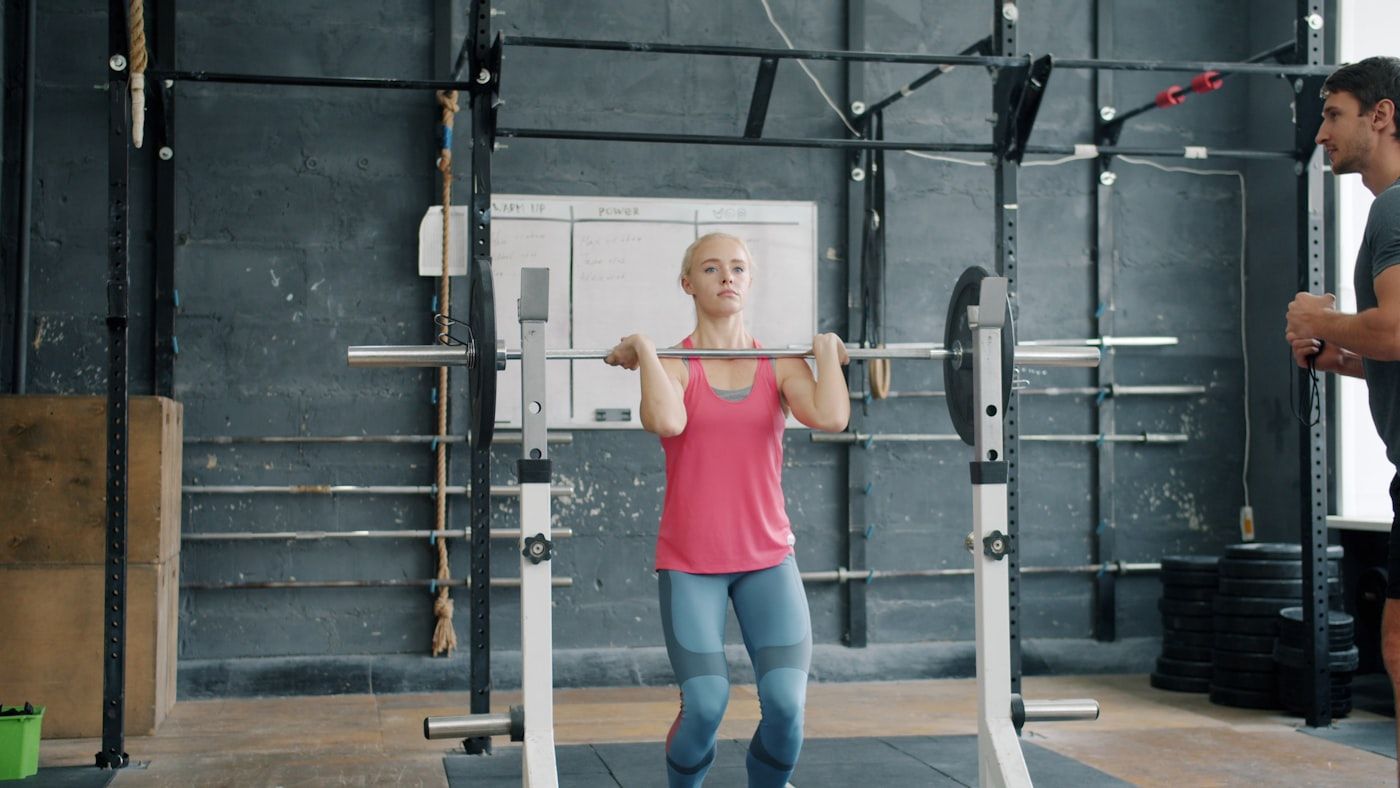
Compound moves like squats load muscle and bone at once, the foundation of menopause strength training.
The key is progressive overload: over the weeks, gradually add a little weight, a rep or two, or a harder version, so your muscles and bones keep adapting. Lifting weights that feel genuinely challenging by the last couple of reps is what creates the benefit, this is not about tiny pink dumbbells for a hundred reps. If you are completely new to this, my how to start strength training guide walks you through the movements gently, and the glute-building guide is useful for the lower body.
How to handle menopause weight gain and belly fat
The shift of fat toward the belly is one of the most common and frustrating menopause changes. First, the honest part: you cannot spot-reduce belly fat with crunches or any single exercise. Belly fat comes off as part of overall fat loss, driven mostly by nutrition, with strength training protecting your muscle so the weight you lose is fat, not muscle.
The approach that works is the same sensible one, adjusted for this stage: strength training two to three times a week to keep muscle and metabolism up, a moderate amount of cardio and daily walking for heart health and extra energy burn, a modest calorie deficit if fat loss is the goal, and enough protein to protect muscle (more on that below). Crash diets are especially counterproductive in menopause, because they strip the very muscle you are fighting to keep. Our weight-loss training guide covers the realistic approach in full, and it applies just as much here.
Protecting your bones
Bone health is one of the most important, and most overlooked, reasons to lift in menopause. The drop in oestrogen accelerates bone loss, and osteoporosis is a genuine long-term risk that quietly develops without symptoms until a fracture happens. Strength training is one of the few things that actively helps: loading your bones through resistance signals them to stay strong, and stronger muscles plus better balance dramatically reduce the risk of the falls that cause fractures.
Weight-bearing, loaded movements (squats, hinges, presses, carries) are the ones that matter most for bone. This is a long game, and the earlier you start, ideally in perimenopause, the more you protect. If you already have a diagnosis of low bone density or osteoporosis, get medical guidance first and work with a coach who can adapt the plan safely.
Nutrition and protein
Nutrition works hand in hand with training in menopause, and protein is the headline. As you age and oestrogen falls, your body is less efficient at building muscle from the food you eat, so getting enough protein becomes more important, not less. Spreading good protein sources across your meals gives your muscles the raw material to rebuild in response to your training.
Beyond protein, the basics still apply: mostly whole foods, enough calcium and vitamin D for bone (worth discussing with your doctor), enough fibre, and sensible calories for your goal. Alcohol and very high sugar tend to hit harder in these years, affecting sleep and belly fat. You do not need a restrictive diet, you need a supportive one. Our nutrition guide and the diet plan for women go into detail, and a good coach ties the eating and training together.
Recovery, sleep and stress
Recovery matters more in menopause, not less. Your body takes a little longer to bounce back, and sleep, so often disrupted at this stage, is when muscle and bone actually rebuild. Training two to three times a week with rest days between, rather than pushing hard every day, gives better results and lowers injury risk.
Managing stress helps too. Chronically high stress raises cortisol, which encourages belly-fat storage and disrupts sleep, so the calmer, walk-in-nature, decent-sleep side of health genuinely supports your training results. In Phuket, gentle morning or evening activity, walking, swimming, easy movement, fits naturally around the heat and complements your strength sessions. Think of recovery as part of the programme, not time off from it.
One practical note for training in Phuket's climate: the heat and humidity add their own load, and hot flushes can make it worse. Train in the cooler early morning or later afternoon, keep water and a towel to hand, and do not be afraid to slow a session down on a bad day. Listening to your body is not weakness, it is how you keep training consistently for the months and years that actually deliver the results.
Perimenopause versus after menopause: is it different?
The principles are the same across the transition, and the earlier you start the better. In perimenopause (the years of fluctuating hormones before your final period), symptoms can come and go and energy varies, so a flexible plan you can dial up or down works well, and this is the ideal time to build strength and bone as a buffer for what follows. After menopause, muscle and bone protection become even more important, and consistency is everything, but the training itself, challenging, progressive, compound-movement strength work, does not fundamentally change.
The reassuring truth is that it is never too late to start. Research shows women in their fifties, sixties and beyond build meaningful strength and muscle when they train, and can regain muscle tone after menopause. You will not get back to exactly where you were at twenty-five, but you can absolutely become stronger, leaner and more capable than you are today, at any age.
Getting started safely in Phuket
If you are new to lifting or coming back after years away, start gently and build. Begin with bodyweight and light dumbbells to learn the movements well, focus on good form over heavy weight, and add load gradually as you get stronger. If you have any medical conditions, a bone-density diagnosis, or significant menopause symptoms, speak to your doctor first, and consider whether medical support such as HRT is right for you, that is a conversation for you and your doctor, alongside, not instead of, exercise.

Start gently, focus on form, and build gradually, it is never too late to begin.
This is exactly the kind of coaching I do across Rawai, Nai Harn, Chalong and Kata and online: helping women train safely and confidently through their forties, fifties and beyond. A coach takes away the guesswork, gets your technique right so you train without injury, and keeps you progressing. If you would value that, read about the benefits of a female trainer or how to choose the right coach, and when you are ready, get in touch and we will build a plan around where you are now.
Related guides
| If you want to know... | Read this guide |
|---|---|
| The wider midlife picture | Personal training over 40 |
| How to start lifting from scratch | How to start strength training |
| Why lifting won't make you bulky | How to get toned without getting bulky |
| How fat loss really works | Weight-loss personal training |
| How a coach helps with diet | Do trainers help with nutrition |
| How long results take | How long to see results |
Frequently asked questions
Should menopausal women do strength training?
Yes. Strength training is arguably the single most valuable exercise in menopause. It protects and rebuilds muscle, strengthens bone, supports metabolism and insulin sensitivity, improves balance and posture, and can ease symptoms like low energy, poor sleep and mood swings. It is both safe and highly recommended.
How many days a week should a menopausal woman lift weights?
Two to three strength sessions a week, on non-consecutive days, is the sweet spot for most women. Consistently training two to three times a week and gradually increasing the weight is what drives the muscle and bone benefits. One session a week is a great place to start.
What is the best strength workout for women after menopause?
A full-body routine built on compound movements: squats, hip hinges or deadlifts, pushing (presses or press-ups), pulling (rows), lunges or step-ups, and some core work. Use dumbbells, bands or bodyweight, lift weights that feel challenging, and gradually add load over time.
Can you get muscle tone back after menopause?
Yes. Strength training is the key to maintaining the muscle you have and rebuilding what you have lost. Women in their fifties, sixties and beyond build meaningful strength and regain tone when they train consistently. It is never too late to start.
How do you lose menopause belly fat and weight gain?
You cannot spot-reduce belly fat. It comes off as part of overall fat loss, driven mostly by nutrition, with strength training protecting your muscle so you lose fat rather than muscle. Combine two to three strength sessions a week, moderate cardio and walking, a modest calorie deficit and enough protein. Avoid crash diets.
Why does menopause cause muscle and bone loss?
Falling oestrogen is the main driver. Oestrogen helps you hold muscle and bone, so as it declines the loss of both speeds up, alongside a shift of fat toward the belly and reduced insulin sensitivity. Strength training directly counteracts these changes.
Is it too late to start strength training after 50?
No. Research consistently shows women starting in their fifties and later build real strength, muscle and bone. You will not reverse the clock entirely, but you can become stronger, leaner and more capable than you are now. Start gently, focus on form, and progress gradually.
How much protein do I need in menopause?
More attention to protein helps, because your body becomes less efficient at building muscle from food as oestrogen falls. Spread good protein sources across your meals to give your muscles the material to rebuild after training. Pair that with enough calcium and vitamin D for bone (discuss with your doctor).
Do I need HRT as well as exercise?
That is a medical decision for you and your doctor. HRT can help some women with symptoms and bone health, but it works alongside exercise, not instead of it. Strength training remains valuable whether or not you use HRT. Always get personalised medical advice for symptoms or a bone-density diagnosis.
Sources
Ready to put this into practice?
Book a free consultation